
CORCON over the last 31 years has emerged as the Asia’s largest and most prestigious corrosion conference on the subject of corrosion science and engineering
“Our nation is building infrastructure at an unprece dented pace! India plans to spend nearly Rs 143,000 crore on infrastructure between the years 2024 and 2030. The Union Budget of 2025-26 alone has marked a record Rs 11.21 lakh crore, which is around 3.1% of our GDP. This is towards capital investment in infrastructure alone. Over the last decade, capital expenditure on infrastructure has grown five fold, and by 2050, India will require around US$2.4 trillion in urban infrastructure investments,” said Mr Dipen Jhaveri, Chair, AMPP India Chapter. He was speaking at the inaugural function of CORCON 2025 at the Jaipur Exhibition and Convention Centre, on October 6, 2025. “These facts make one thing clear, that as India builds more pipelines, refineries, petrochemical units, steel plants, power plants and fertilizer units, more water systems and urban infrastructure, the demand for robust corrosion protection technolo-gies have never been greater.”
“CORCON brings together the best minds and organizations to address these challenges,” said Mr Jhaveri. “CORCON has grown over the last three decades into Asia’s largest corrosion conference, serving as a global platform for enhancing knowledge and best practices, showcasing innovations and technologies, building collaborations across industries, academia, and research, and also inspiring the next generation of corrosion professionals.”
This year, the 31 edition of CORCON hosted over 800 delegates, 80-plus exhibitors, and a remarkable lineup of eminent speakers from around India and the world.
“As the country evolves, one thing which will also evolve with the country is corrosion,” said Mr K. B. Singh, Chairman – CORCON 2025. “If we look into the vision of what our Prime Minister has today on Atmanirbhar Bharat, we will become the third-largest economy in a few years from now. So, the cost of corrosion will also increase. What does that mean? It basically implies that we have to get in new technologies and trained manpower to arrest and reduce the cost of corrosion. Technologies will emerge, digital technology will emerge, and artificial intelligence is also emerging. So what does that bring to all of you? It brings a huge amount of responsibility as well as a huge amount of opportunity for all of you to grow. India as we read, is one of the youngest nations in terms of human population. Young engineers and scientists can use this platform to exchange ideas and foster innovations.”
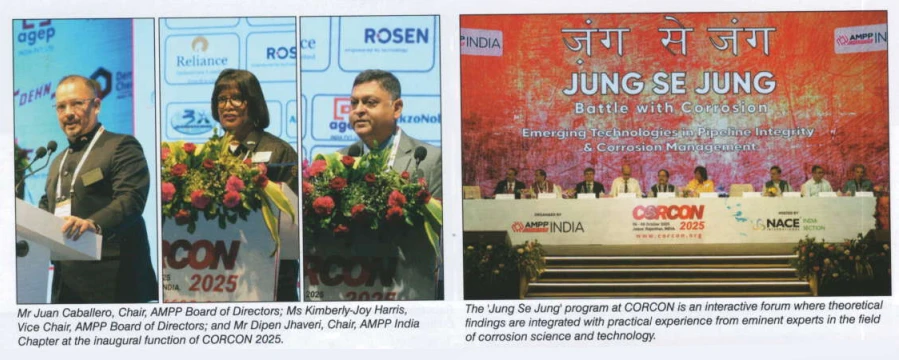
Mr Juan Caballero, Chair, AMPP Board of Director, who was the chief guest at the event, said, “I am very proud to recognize the vital role the regional chapters play in advancing solutions at the local level while shaping progress on the global scale.
look forward to seeing India as a leading example on uniting the world to fight and mitigate corrosion.”
Ms Kimberly-Joy Harris, Vice Chair, AMPP Board of Directors, noted: “This is a great opportunity to network, to meet people, learn new ideas. There’s an honest amount of exhibitors here. I love my exhibitors because they provide the resources and the technologies that’s needed for me as an owner-operator to ensure that our assets are always safe to operate.”
Spread over three days, the 25 symposia sessions (4 plenary talks; 10 keynote talks; 170 contributory papers and 18 poster presentations), covered topics like cathodic and anodic protection, materials and composites, corrosion monitoring and testing, corrosion in renew-able energy, nuclear and power utilities, coatings linings and thermal insulation, microbial corrosion and inhibitors, corrosion control in water treatment utilities, direct assessment methodology application, corrosion in concrete and infrastructure, marine corrosion, corrosion in oil and gas sector, corrosion in petrochemical, refineries and fertilizer industry, forums for young students and scientists. There were four plenary talks, the first one being Field Lessons to Strategic Vision: AMPP as a Lighthouse for Corrosion Management in Marine and Industrial Assets by Mr Juan Caballero, Chair, AMPP Board of Directors. The others were Corrosion Challenges in India’s Water Infrastructure by Mr Hemen V. Patel, Chairman, AWWA India Association; R&D Remote Asset Integrity Monitoring by Dr Kimberly-Joy Harris, Vice Chair, Board of Directors, AMPP; and Non-Intrusive Pipeline Inspection for City Gas, Water Crossings and HDD Locations by Mr Mark Glinka, EMPIT GmbH. Germany.
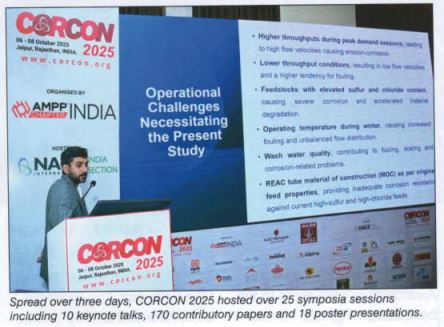
The Technical Interactive Forums (TIFs) had topics like Cathodic Protection – AC/DC Interference Mitigation; Corrosion Control of City Gas Distribution; Corrosion in Petrochemical Plants and Refineries; Corrosion Monitoring and Integrity Management; and Pipeline Integrity Management Systems. A Workshop on Marine Corrosion and Corrosion in Defence Sector and a Round Table Confer-ence on Protective Coatings and Lining Industry, besides a Poster Presentation session were some of the other highlights of the event.
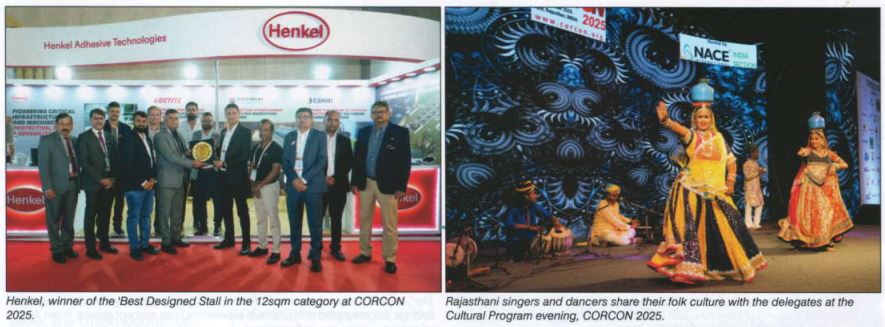
CORCON 2025 was not only about heavy corrosion mitigation stiff, but also had its share of fun and mirth. The cultural program organized in the evening of the opening day had Rajasthani singers and dancers enthralling and sharing their folk culture with the delegates who had flown in from across the globe. The dinner area that evening was converted into a village fair like atmosphere with its share of handloom and handicraft sellers, bangle makers, fortune tellers, and portrait artists.
One of the major highlights at every CORCON is the AMPP India Chapter’s Corrosion Awareness Awards (AIC) presented to honor and respect individuals/institu-tions for their contribution to corrosion awareness and development in the field of corrosion science and technology in India. This was held on the evening of the second day of the event. AIC has so far honoured 157 scientists, teachers, engi-neers, professionals, 58 students’ innovation and 29 public/private sector laboratories, etc.
This year, the award winners were Dr (Ms) Geogy J. Abraham, Bhabha Atomic Research Centre, Mumbai for Excellence in Corrosion Science & Technology in Research and Education; Mr Satendra Kumar, Welspun Corp Ltd., Anjar for Excel-lence in Corrosion Science and Technology in Industrial Organization; Dr C. Arunchandra, CSIR-Central Electrochemical Research Institute (CECRI), Karaikudi for Distinction in Corrosion Science and Technology in Research and Education; Dr M. Ajay Krishnan, Shell Technology Centre, Bengaluru for Distinction in Corrosion Science & Technol-ogy in Industrial Organization; Indian Oil Corporation Ltd., Faridabad for Excellent Laboratory; and Dr Gopinath S., Indira Gandhi Centre for Atomic Research, Kalpakkam, the Student Award for PhD Degree. The Lifetime Achieve-ment Award went to Dr R. K. Malhotra, former Director, IOCL (R&D), Delhi.
Mr Premchand Bairwa, the Hon’ble Deputy Chief Minister of Rajasthan, was the chief guest at the glittering AMPP India Chapter’s Corrosion Awareness Awards function. While thanking the organizers for choosing Rajasthan’s Pink City, Jaipur as the venue, he said: “In a vast and water-stressed state like Rajasthan, the biggest threat of corrosion is reflected in our water infrastructure. The reliability of our pipelines, reservoirs, and pumping systems is extremely important. Corro-sion poses a double threat to these systems, leading to leakages, reduced water flow, higher maintenance costs, and a massive waste of water. Furthermore, harmful elements from corroded metal pipes mix into the drinking water, adversely affecting the health of the common public. Our effort to provide water to every household through the Jal Jeevan Mission will only be successful when we ensure corrosion-free, sustainable piping and structural systems.”
“We are also investing heavily in our basic infrastructure, whether it is Greenfield projects, expressways, urban development projects, or water supply networks. We are laying a strong foundation for the future of Rajasthan. However, in the path of this rapid development, corrosion is a serious and silent danger This is not just a technical problem; it is an economic burden that affects the lifespan of assets, public safety, and the prosperity of the nation,” he said.
“The time has now come for us to move beyond the old mind-set of repair and replacement and adopt a strategy of prediction and prevention. The solution to these challenges of corrosion will not come from temporary measures. Instead, we need long-term solutions based on advanced material science, cathodic protection, and advanced coatings. I call upon all global leaders, researchers, and award winners of the AMPP India Chapter to become partners in our journey. The Govern-ment of Rajasthan needs your expertise!”
The expo area featured around 80 stalls, not only the leading names in the industry from across the country, but all over the globe exhibiting their latest innovations, products and processes. Awards were also given to the best designed stalls. Henkel was awarded the Best Stall and Alleima, the runner-up in 12 sqm category. Vee Kay Vikram was awarded the best stall and DEHN India, the runner-up in 9 sqm category respectively. This year viewer’s choice for the best stall was the given to Electrotherm India Pvt Ltd. Besides these, awards were also given to the best papers and poster presentation at the valedictory function. The valedictory function was graced by the foreign dignitaries who glorified the experience of this CORCON and wished the India Chapter to grow from strength to strength.
The meeting concluded with a Vote of Thanks by Mr Denzil D’Costa, Treasurer of AMPP India Chapter. He thanked the event manager, master of ceremonies and the hotel management for the sumptu-ous meals and the facilities provided. He also mentioned the tireless work done by the staff Mr Manoj Mishra, Mr Rishikesh Mishra, Mrs Anita D’Souza, Ms Ankita Rane, Mrs Manisha Rewale for the huge success of CORCON 2025.
CORCON 2026 will be held in Goa next year. The dates will be announced shortly.